

The ADEO (Drag Augmentation Deorbiting System), developed by HPS, is a scalable product family of deployable drag sails designed to accelerate the deorbiting of satellites and launch vehicle components in low Earth orbit. By increasing atmospheric drag, it passively reduces orbital lifetime without requiring additional propellant or active attitude control, supporting responsible end-of-life disposal and space debris mitigation.
- ID Number
- 4
- Entity Name
- HPS GmbH
- Country
- Germany
- Type of Organisation
- SME
- Type of Entry
- Technology
- Technology Readiness Level (TRL)
- 9
- Contact details
- Last checked
- Link to webpage
- https://www.hps-gmbh.com/#adeo (opens in a new tab)
Abstract
Description
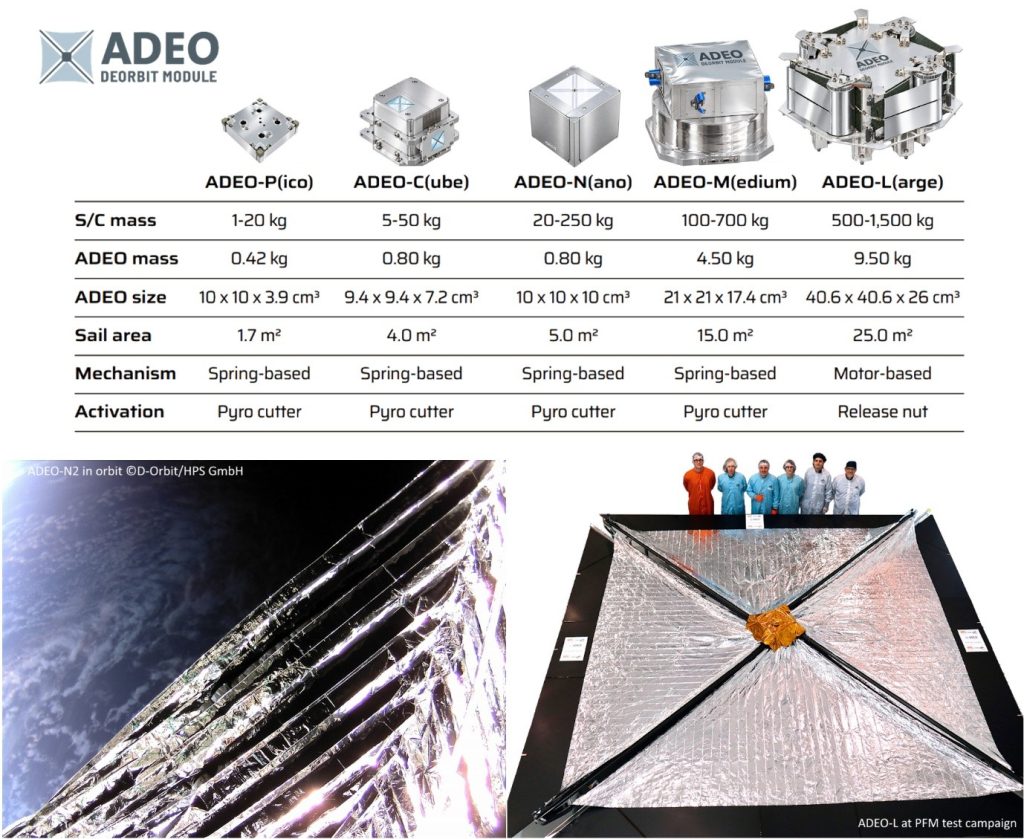
The ADEO modules, developed by HPS GmbH, are a family of deployable drag-augmentation subsystems designed to accelerate the end-of-life disposal of satellites and launch vehicle components in low Earth orbit (LEO). It deploys a lightweight sail to increase the spacecraft’s effective aerodynamic area accelerating orbital decay without requiring propellant or active guidance, navigation and control during deorbit. ADEO ensures the compliance to 5-year deorbiting rules for spacecrafts after end of misson. Additional autonomous release electronics (ARE) are available in order to implement ADEO as a deorbit solution which acts fully independent from the spacecraft.
The product family covers spacecraft masses from approximately 1 kg to 1,000 kg, with configurations including ADEO-P, ADEO-C, ADEO-N, ADEO-M and ADEO-L. Sail areas vary from approximately 1.7 m² for ADEO-P to 25 m² and larger for ADEO-L. The modules use compact stowed architectures and deployable membrane structures, with deployment mechanisms tailored to the subsystem class.
ADEO can be integrated as a primary disposal system or as a redundant end-of-life mitigation measure. Depending on the configuration, deployment can be initiated by command or with autonomous deployment options (ARE) available in case of spacecraft failures. Its performance depends on spacecraft mass, deployment altitude, orbital conditions, atmospheric density and effective drag area; therefore, compliance with a specified disposal timeframe must be assessed for each mission rather than assumed.
The ADEO family has demonstrated in-orbit deployment heritage, including early missions on a Rocket Lab Electron kick stage and D-Orbit’s ION satellite carrier. It provides a scalable, low-mass approach to reducing post-mission orbital lifetime and limiting the long-term accumulation of space debris.
Technical classification
- Technical Domains
-
- TD2 GUARANTEE TIMELY AND SUCCESSFUL CLEARANCE
- Needs
-
- 2.1 IMPROVE ORBITAL CLEARANCE WITH HIGH PROBABILITY OF SUCCESSFUL DE-ORBITING
- Solutions
-
- 2.1.A Development and/or adoption of safe and reliable de-orbiting systems and operations for different orbital regions and object characteristics
Evidence for TRL
Flight Heritage