

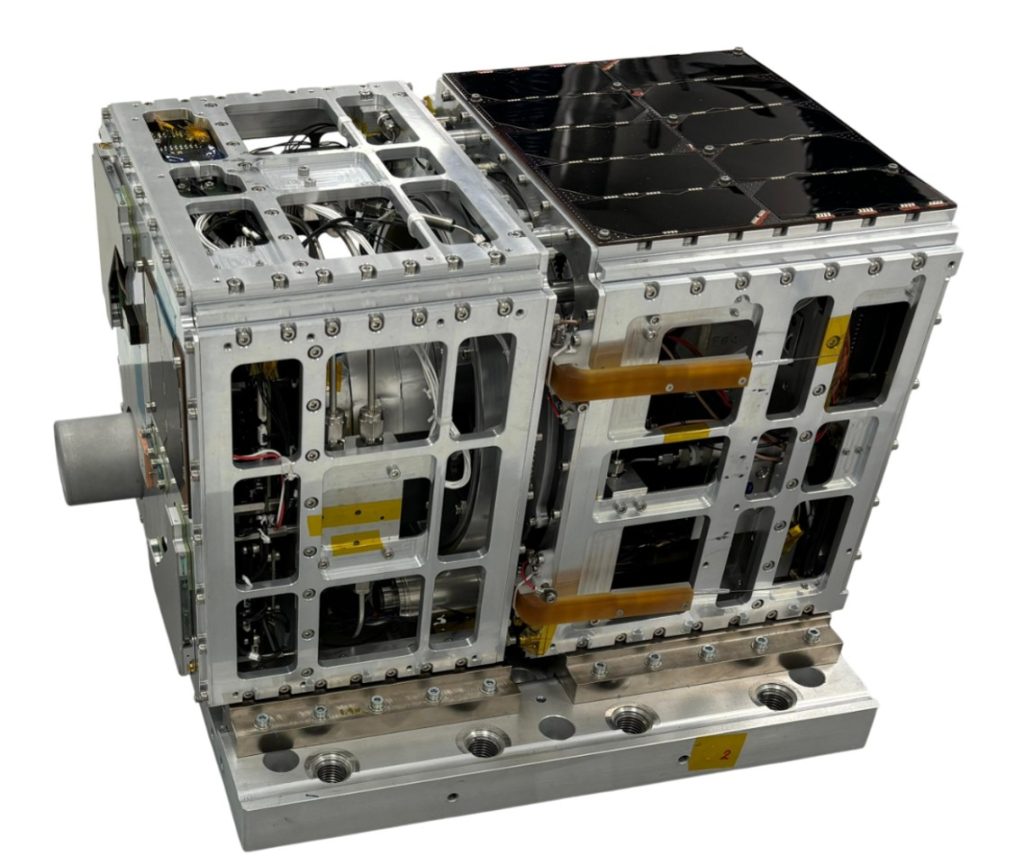
PEARSON is a new-generation autonomous deorbit device that leverages propellant-free electrodynamic tether technology for sustainable end-of-life deorbiting of satellites and launcher upper stages. It will be commercialised by PERSEI Space based on the lessons learned from the E.T.PACK-F deorbit device and its in-orbit demonstration.
- ID Number
- 3
- Entity Name
- PERSEI Space
- Country
- Spain
- Type of Organisation
- Start-Up
- Type of Entry
- Technology
- Technology Readiness Level (TRL)
- 6
- Contact details
- Last checked
Abstract
Description
PEARSON is an autonomous, propellant-free deorbit device based on ElectroDynamic Tether (EDT) technology [1], currently at TRL 6. It is designed for integration with spacecraft before launch as an end-of-life disposal system or for deployment as a payload in Active Debris Removal (ADR) missions.
Within the ECO-Tethers activity, funded by the European Space Agency (ESA), PERSEI Space has defined three variants of PEARSON according to the orbital altitude and inclination and the mass of the host object: PEARSON-S, PEARSON-M and PEARSON-L, with expected masses of about 15 kg, 22 kg and 40 kg, respectively. PEARSON-S and PEARSON-M address most scenarios, while PEARSON-L is intended for heavy hosts (about 1000 kg) at high altitudes and inclinations.
The performance of the PEARSON family has been assessed through a simulation campaign with the BETsMA v2.0 mission analysis software [2], for which Universidad Carlos III de Madrid (UC3M) has granted PERSEI Space an exclusive licence. The family covers orbits from equatorial to sun-synchronous inclinations and altitudes up to 1200 km. In the simulated scenarios, with host masses from 100 kg to 1000 kg, the deorbit time is well below the 5-year post-mission disposal time. For instance, PEARSON-M can deorbit a 1000 kg satellite from an 800 km orbit with an inclination of 45° in about 3 months (87 days), and PEARSON-L can deorbit a 1000 kg satellite from an 800 km sun-synchronous orbit (98° inclination) in about 6 months (179 days).
PEARSON builds upon the E.T.PACK-F deorbit device, which was developed under the European Innovation Council (EIC) projects E.T.PACK and E.T.PACK-F. This device (19 kg, 12U), designed for the deorbiting of satellites with masses exceeding 200 kg, consists of an Electron Emitter Module (EEM) and a Deployment Mechanism Module (DMM), and deploys a 430 m aluminium tape tether with a hollow cathode as electron emitter. To operate autonomously, it includes solar panels, Ultra High Frequency (UHF) and S-band antennas, and its own avionics. Its Engineering Qualification Model (EQM) successfully completed an extensive qualification campaign [3]. The E.T.PACK-F deorbit device has reached TRL 8, and its in-orbit demonstration (IOD) is scheduled for 2027. The lessons learned from the qualification campaign and from the IOD will be incorporated into the design of PEARSON. The PEARSON variants will be developed sequentially, starting with PEARSON-S, which requires limited changes with respect to the E.T.PACK-F deorbit device.
PERSEI Space is a signatory of the Zero Debris Charter.
References:
[1] G. Sánchez-Arriaga, E. C. Lorenzini and S. G. Bilén, “A review of electrodynamic tether missions: Historical trend, dimensionless parameters, and opportunities opening space markets”, Acta Astronautica, vol. 225, pp. 158–168, 2024. Available at: https://doi.org/10.1016/j.actaastro.2024.09.002
[2] G. Borderes-Motta, G. de Haro-Pizarroso, G. Li, H. Yu, Z. H. Zhu, G. Sarego, G. Colombatti, E. C. Lorenzini, J. K. McTernan, B. E. Gilchrist, S. G. Bilén, S. Kawamoto, Y. Ohkawa and G. Sánchez-Arriaga, “Cross-verification and benchmarking analysis of electrodynamic tether simulators”, Acta Astronautica, vol. 208, pp. 381–388, 2023. Available at: https://doi.org/10.1016/j.actaastro.2023.04.015
[3] G. Sánchez-Arriaga, M. Tajmar, A. Valmorbida, X. Ezara, E. Kiema and J. M. Muñoz Tejeda, “Technology Progress and In-orbit Demonstration of Electrodynamic Tethers in the framework of the E.T.PACK Initiative”, Proceedings of the 9th European Conference on Space Debris, Bonn, Germany, 1–4 April 2025. Available at: https://conference.sdo.esoc.esa.int/proceedings/sdc9/paper/166/SDC9-paper166.pdf
Technical classification
- Technical Domains
-
- TD2 GUARANTEE TIMELY AND SUCCESSFUL CLEARANCE
- Needs
-
- 2.1 IMPROVE ORBITAL CLEARANCE WITH HIGH PROBABILITY OF SUCCESSFUL DE-ORBITING
- Solutions
-
- 2.1.A Development and/or adoption of safe and reliable de-orbiting systems and operations for different orbital regions and object characteristics
Evidence for TRL
PEARSON is at TRL 6 according to ECSS-E-HB-11A (model demonstrating the critical functions of the element in a relevant environment). PEARSON is based on the same EDT technology [1] as the E.T.PACK-F deorbit device, which is at TRL 8 (actual system completed and accepted for flight). PEARSON-S and PEARSON-M keep the stationary multi-coil deployment mechanism of E.T.PACK-F (TRL 8) with minor modifications, whereas PEARSON-L requires a rotary single-coil deployment mechanism, currently under development in the EIC project E.T.COMPACT.
The E.T.PACK-F EQM underwent an extensive qualification campaign [2] to validate the fulfilment of the requirements. It included proof pressure and leak tests, partial and full tether deployment tests, vibration and shock tests at Vega-C qualification levels, thermal vacuum cycling, electromagnetic compatibility tests (conductive, radiated and magnetic dipole characterisation) and a module separation test, with functional tests after each of them. The corrective actions derived from these tests were verified in a delta-qualification campaign, which concluded with two successful end-to-end full tether deployment tests. The qualification campaign was complemented with extensive simulation analyses and tests on individual subsystems, such as the hollow cathode, the communication subsystem and the in-line damper.
References:
[1] G. Sánchez-Arriaga, E. C. Lorenzini and S. G. Bilén, “A review of electrodynamic tether missions: Historical trend, dimensionless parameters, and opportunities opening space markets”, Acta Astronautica, vol. 225, pp. 158–168, 2024. Available at: https://doi.org/10.1016/j.actaastro.2024.09.002
[2] G. Sánchez-Arriaga, M. Tajmar, A. Valmorbida, X. Ezara, E. Kiema and J. M. Muñoz Tejeda, “Technology Progress and In-orbit Demonstration of Electrodynamic Tethers in the framework of the E.T.PACK Initiative”, Proceedings of the 9th European Conference on Space Debris, Bonn, Germany, 1–4 April 2025. Available at: https://conference.sdo.esoc.esa.int/proceedings/sdc9/paper/166/SDC9-paper166.pdf