ESA title

CONTACT US

Learning Hub The ESA Learning Hub is a web-based platform which provides access to training courses and materials linked to ESA programs and initiatives

Matchmaking ESA-Match is a platform that lets companies showcase their competences and capabilities, find partners, explore commercial opportunities and establish business relationships

Intellectual Property ESA makes its intellectual property available to European space companies within its 22 Member States, on a freely-licensed basis

ESA Patents

CONTACT US

    * Mandatory field

    Events

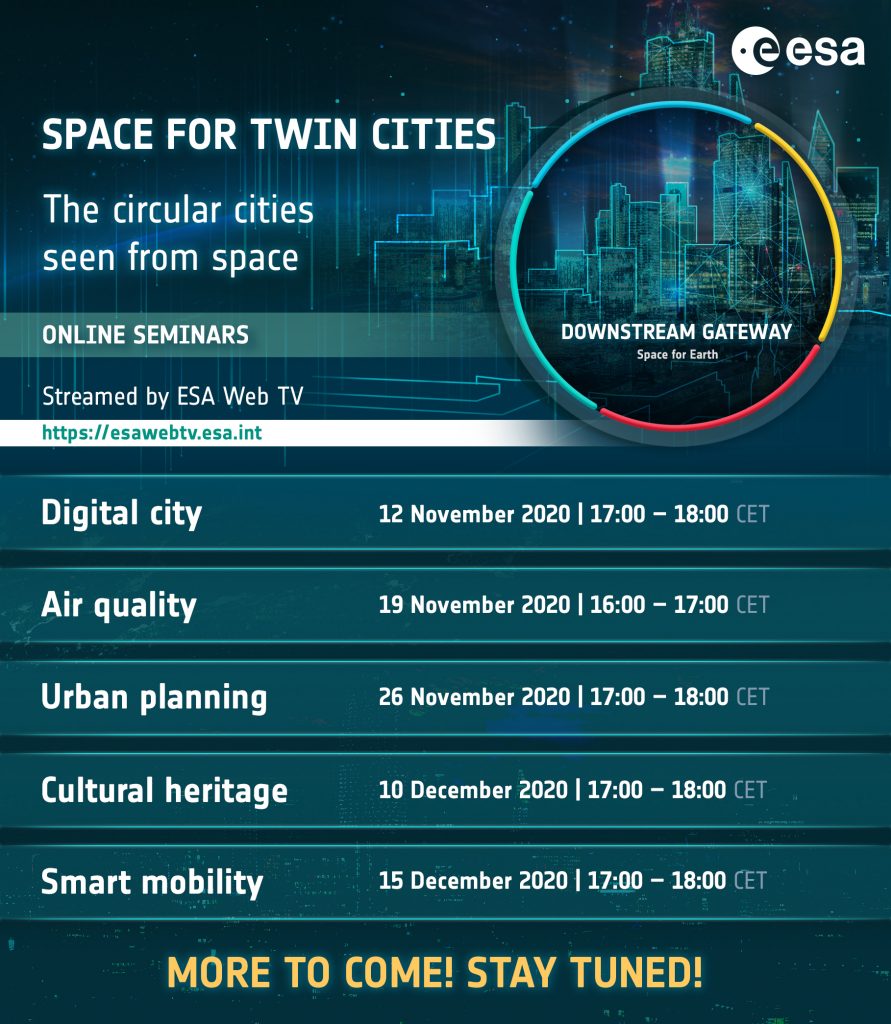
    Online Seminars: Space for Twin Cities

    The Circular Cities seen from space


    Citizens are nowadays part of the urban innovation ecosystem.   Urban smart innovation is perceived as a change process set in motion and continually designed by people who become more vocal and acquire a new role in the urban decision-making process. In this context, cities are data-driven to meet the citizen’s needs. Thus, allowing city systems and services to be responsive and act upon data in real-time. The generation, analysis and sharing of large quantities of data (including  satellite data) is not only useful for local governments to deliver better smart city solutions, but also results in revenue for businesses managing such data.  

    Space verticals have a key role to play in the smart city ecosystem as a technological enabler, at the core of cost-efficient business models.

    Smart Urbanization in all areas is done with a clear focus on the climate change challenges. The global challenge to reduce the greenhouse gas emission to zero by 2050 ( European Green Deal)  or remove them from the air implies a series of mitigation actions adopting new technologies, improving efficiency of older equipment and protecting natural carbon sinks. Five sectors account for over 90% of gas emissions: energy, transport, agriculture, industry and the built environment. Those sectors are equally strategic in the smart cities ecosystem. Global Events, like the Paris 2024 Olympics, entail new business opportunities. They drive the attention on climate change challenges; increase the awareness on waste management, efficient energy systems, smart buildings, urban forestry, focus on renewable energy and on smart transport policy. In fact, the Paris 2024 will endeavor to be the first Games fully aligned with the Paris Climate Agreement and the Olympic Village will be a showcase of sustainable development with low carbon and eco-designed buildings, using 100 per cent renewable energy and having a zero waste policy strategy. In this context,  the use of space assets is beneficial in many areas like  smart mobility, air pollution monitoring, waste management, urban planning, urban agriculture managing etc.  In green building, the use of space data can support surveying sustainable friendly locations for site selection, mapping natural resources to include in building’s design, tracking off-site pre-fabricated modules of green buildings to construction site and  mapping thermal insufficient buildings. The use of Artificial Intelligence  combined with Earth Observation multi-spectral satellite data and SAR  data, in-situ surveys and forest growth models  can provide  a service (available on Desktop or mobile devices)  aimed at providing consistent and statistically reliable information on urban forests, to monitor natural and planted forests growth and forest losses due to human activities or to natural phenomena (see MAFIS project).

    Currently, most smart city models provide solutions in silos and are not interconnected. The future is moving toward providing for integrated solutions that connect all verticals under a single platform. Internet of Things (IoT) is already paving the way to allow for such solutions. Deploying sensors for city-wide data acquisition across the city to continuously measure various city parameters real time will be crucial for cities of the future. The IoT enables ordinary objects, e.g. household appliances, to use the Internet to become smarter. This allows them to collect data and connect to other devices to make everyday tasks easier and more efficient. The COVID-19 pandemic also highlighted the need of evolving towards an enhanced digitalisation in the HealthCare, Education and Working systems.  IoT is set to have the most impact on industries in the future, as most devices will soon be able to collect or process data and be controlled remotely. In this context, space data and assets combined with in-situ data are an important enabler.

    In the smart city context, safety and cybersecurity are hot button issues, in both the public and private sector. Cybersecurity is a key enabler for the development of data-driven services and ubiquitous connectivity (network or satellite). The complexity of city’s systems interdependencies, globally connected social, economic and political sub systems has increased the vulnerability of a city’s security. The cyber threats are magnified as infinite supply of data (including satellite-transmitted data) become integral to a wide array of operations and services.

    Municipalities and local governments, who showed to be key players in the management of the COVID -19 pandemic are facing the unprecedented acceleration towards smart solutions. ESA has already a relevant position in the smart cities ecosystem with a portfolio of activities ongoing or planned in support. With the objective  to understand the needs and trends, the synergies and the best practises  ESA is launching a digital networking initiative among  Municipalities all over the world, having  adopted space enabled smart solutions  called Space for Twin Cities.


    A first series of online seminars  is foreseen in the period November – December 2020. The events will be streamed by ESA TV TWO.


    Related news

    08 July 2025
    Inverto Earth: Championing Sustainability at the Prix Bulles Cardin

    The Prix Bulles Cardin, an annual celebration of innovation in space and ocean exploration, has once again highlighted the transformative potential of technology in building a sustainable future. At the...

    17 January 2025
    Fly Me to the Moon webinar series with the European Business Angels Network (EBAN)

    The European Space Agency’s directors will be featured in the “Fly Me to the Moon” webinar series with the European Business Angels Network (EBAN), presenting the latest advancements in space....

    23 December 2024
    Motion Products redefines the Infrastructure Management with Satellite Technology

    The European Space Agency plays a pivotal role in fostering innovation and supporting start-ups within the space technology sector. Through initiatives like the ESA Business Incubation Centre (BIC) programme, ESA...

    16 December 2024
    From Incubation to Innovation: Open Cosmos and ESA’s Collaborative Journey

    Open Cosmos, an alumnus of ESA Business Incubation Centre (ESA BIC) in Harwell, UK, has had an eventful journey in 2024. Having closed over €100 million in contracts, the company...

    09 December 2024
    ESA’s Green Transition Information Factories (GTIF): Driving Innovation and Sustainability Towards Carbon Neutrality

    The ESA Green Transition Information Factories (GTIF) are an online ecosystem of solutions, powered by Earth Observation and other geospatial data, that allows users to interactively discover the underlying opportunities...

    Keep updated on all ESA opportunities

    Subscribe to our newsletter or visit our Help page for quick answers

    Subscribe to newsletter Get Help